Have you ever stared out your window after a heavy rainstorm and wondered why your yard looks like a swamp? Proper surface drains & catch basins are often the missing piece to a dry yard.
We know exactly how stressful it is to watch water creep closer to your foundation. At OKC French Drains, our team has handled every kind of pooling issue across the metro as part of complete yard drainage in Oklahoma City.
Good drainage is the key ingredient to a dry, usable lawn.
I am going to walk you through the exact steps to fix those low spots for good. So, grab a cup of coffee, and let’s go through it together.
What catch basins do (and what they don’t)
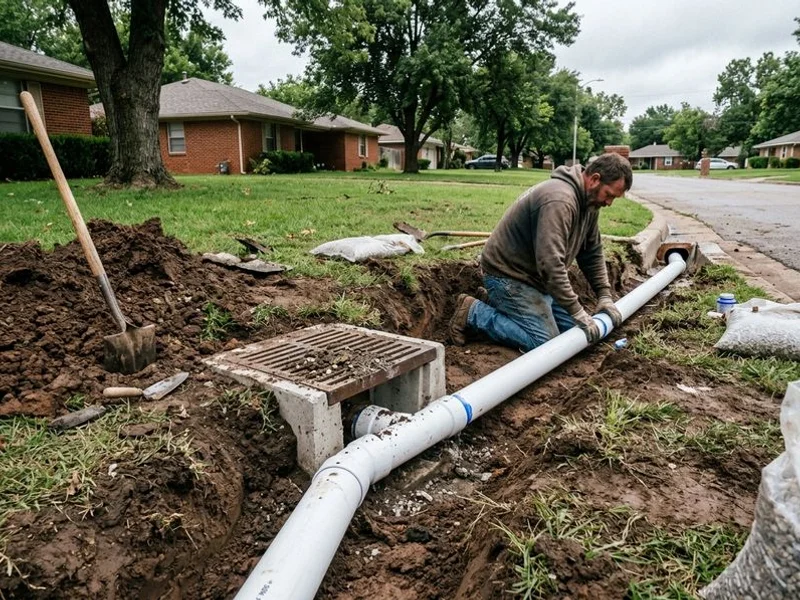
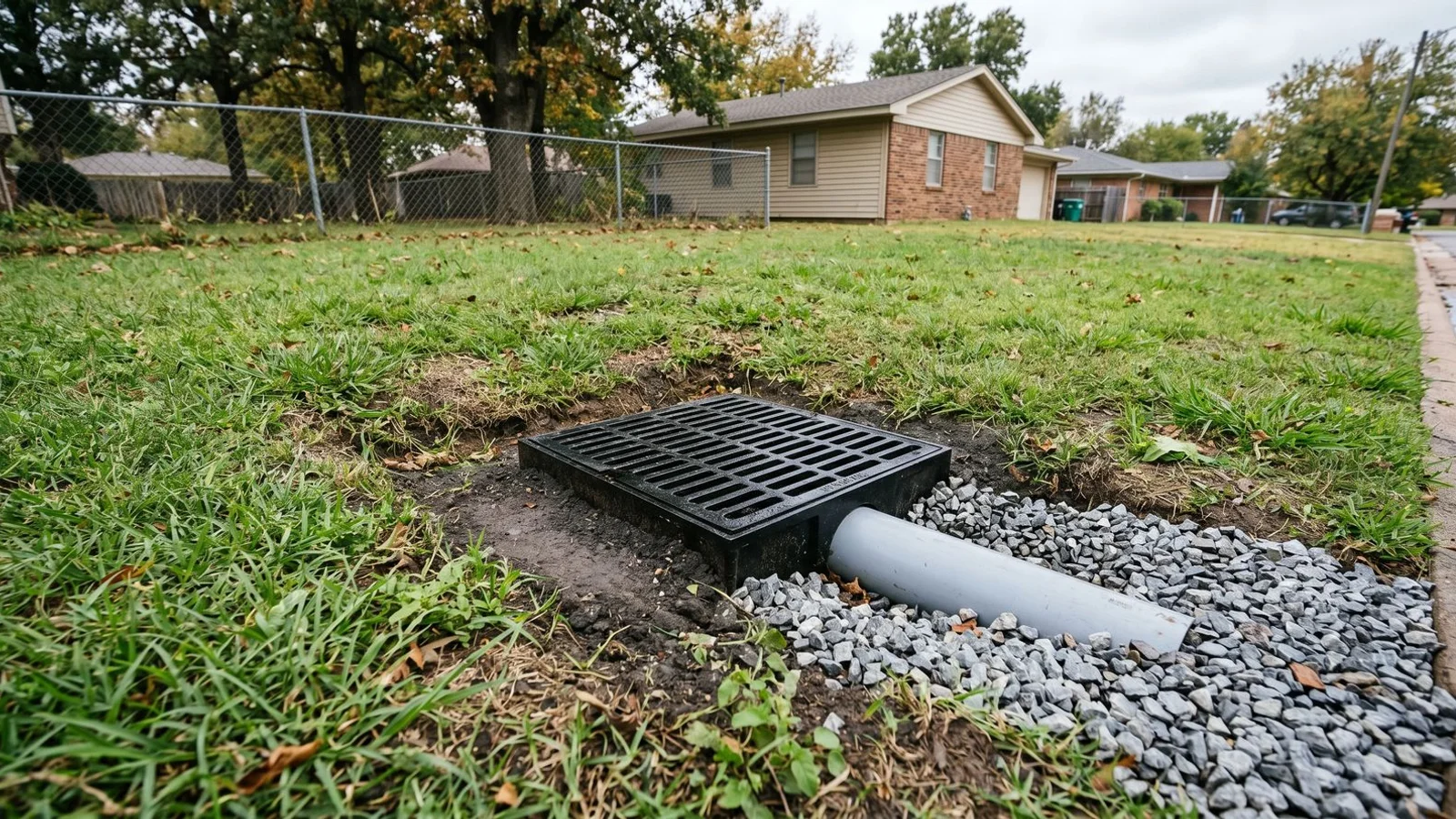
The secret to managing this water relies on surface drains & catch basins. A catch basin is a grate-topped inlet set flush with the yard surface. Water flows across the grass, drops through the grate, and exits through smooth-wall pipe to a discharge point.
They handle the surface runoff that doesn’t get the chance to soak in fast enough during flash-flood storms. We see this overflow constantly, considering Oklahoma City gets an average of 36 inches of annual rainfall. That much water can overwhelm any yard quickly if it has nowhere to go.
What catch basins do well:
- Capture pooling water in low spots before it sits and kills grass
- Drain flowerbeds and planters that stay soggy and ruin plant roots
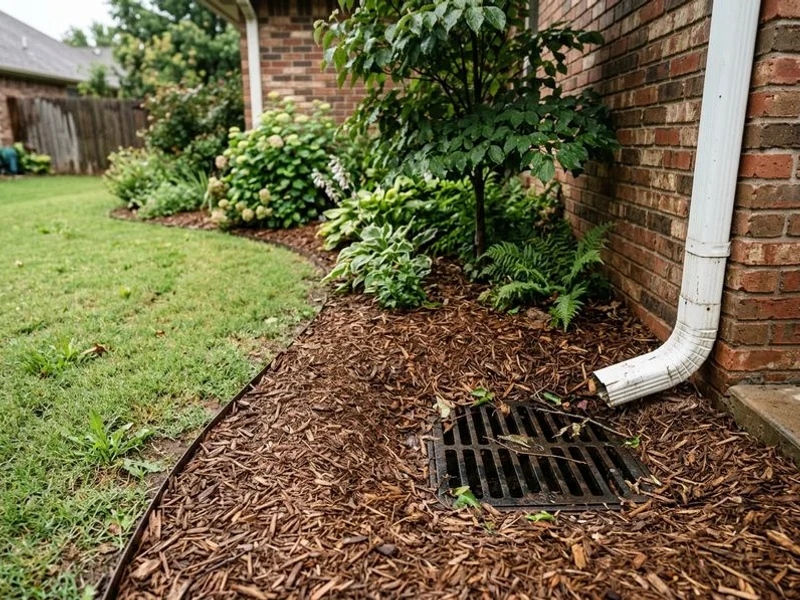
- Handle the heavy flow from downspouts so the water stays safely away from the foundation
- Drain driveways, patios, and pool decks through low-profile channel drains
They simply can’t pull water that is already saturating the soil out of the ground. That is the job of a French drain. Most properties require both systems to stay completely dry.
Here’s how the three surface-water tools compare so you know which one your yard actually needs:
| Drainage tool | Best for | What it won’t do |
|---|---|---|
| Catch basin | Pooling in low spots and at downspouts | Pull water already trapped in the soil |
| Channel drain | Driveways, patios, and pool decks | Drain an open lawn area |
| French drain | Saturated ground and high water tables | Capture fast sheet-flow runoff on its own |
Why placement matters more than the basin itself
The most common failure happens when the grate sits in a flat spot. The yard misses the slope entirely, causing most of the rainfall to just go around the inlet. A basin only works on the few square feet directly above the grate. Water will just sit there if the grate is even a half-inch too high.
We solve this during the on-site evaluation by mapping the exact topography. A professional laser level, like a Topcon or Bosch system, reveals the true low points of your property.
Pro Tip: Never guess your yard’s slope. Always use a laser level to find the true low points before digging a single trench.
Relying on the naked eye is a huge mistake that many contractors make. You might think you know where the water gathers, but the actual lowest point is sometimes eight feet away from the obvious puddle.
Our crews either set the basin in those verified low points or regrade the yard to feed water directly to the inlet. The grate is just the inlet, but the grading is the actual system.
How we install them
1. Find the low points
Our installation process starts with a precise walk-through and laser mapping. Accurate mapping saves you from paying for a system that misses the mark.
We identify where water actually pools instead of guessing. You’d be surprised how often the real problem area is hidden.
2. Excavate and set the basin
Standard residential basins are 9-inch or 12-inch NDS-style grate basins. We match the grate load ratings to your specific needs, whether the basin sits in a lawn, flowerbed, or driveway. For example, a Class A NDS grate is perfect for normal foot traffic in a garden.
A Class B grate handles up to 12,150 pounds, making it ideal for residential driveways and lawn tractors. Our team excavates to the right depth, sets the basin flush with the grade, and locks it in with compacted soil. Proper compaction prevents the basin from shifting over time.
3. Run smooth-wall pipe to the exit
Smooth-wall pipe is always our choice for the run from the basin to the exit. Corrugated pipe has ridges that trap debris and slow down the water flow. Science actually backs this up with something called Manning’s Roughness Coefficient.
The coefficient for smooth PVC pipe is a very low 0.009, meaning water glides right through it. Corrugated pipe scores a much higher 0.022, creating friction that leads to nasty clogs.
We slope the smooth pipe at a minimum of 1 percent to ensure gravity does the heavy lifting. That translates to about an inch of fall per 8 feet of pipe.
4. Regrade where needed
Sometimes the yard doesn’t naturally feed the basin. Our team regrades the surrounding turf with a gentle slope angled to the grate. This subtle change captures the runoff effectively.
The regrading work becomes invisible once the grass recovers in a few weeks.
5. Discharge to code
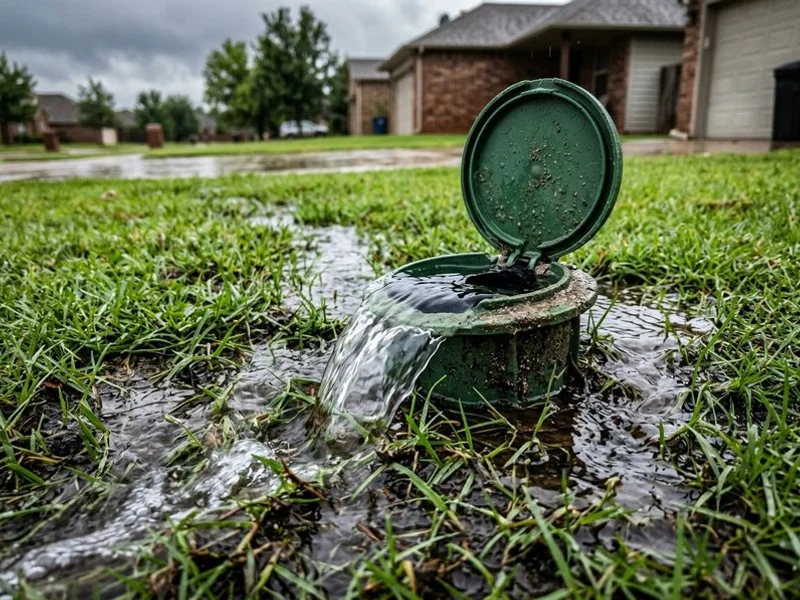
The exit point is the part most cheap installations get wrong. We discharge the water to a pop-up emitter set safely away from foundations. Chapter 16 of the Oklahoma City Municipal Code outlines strict rules for stormwater drainage.
Dumping water directly against your neighbor’s fence is a clear violation. Proper discharge requires routing the water to a street curb fitting or daylighting it onto a safe slope.
Our installers place pop-up emitters at a safe distance from property lines to avoid neighbor disputes. This keeps your yard dry and keeps you out of legal trouble.
When to combine catch basins with a French drain
A surface drain alone is enough under certain conditions:
- The yard has clear low points where water collects on top of the soil
- Drainage problems are limited to a few days of pooling after big storms
- The foundation is dry and the basement avoids taking on water
You need catch basins plus a French drain or sub-surface system when facing more severe issues:
- Water is showing up at the foundation or inside the basement
- The soil stays saturated for days between rain storms
- Multiple low spots feed into each other and overwhelm surface drains
- The lot features heavy clay subsoil that prevents water from soaking down
Here is a quick breakdown to help you decide:
| Drainage Problem | Best Solution | How It Works |
|---|---|---|
| Flash flooding on grass | Catch Basin | Collects top-level surface water instantly. |
| Soggy, spongy soil | French Drain | Pulls trapped groundwater out of the soil. |
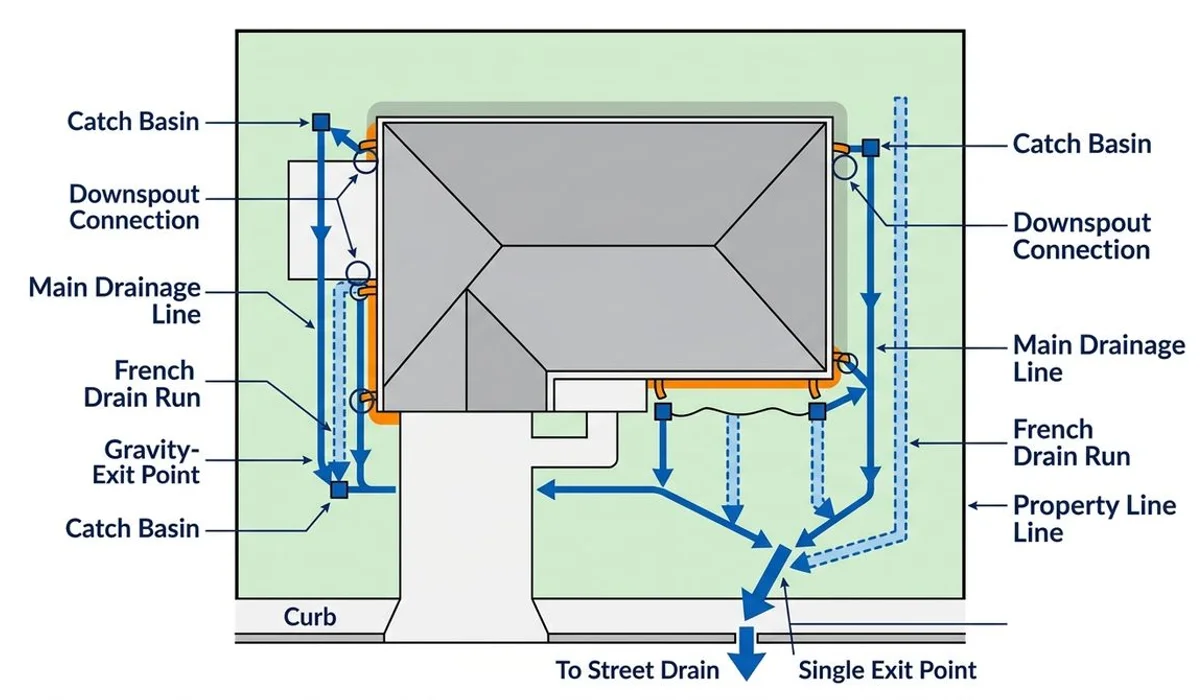
| Both surface pooling and squishy lawn | Unified System | Combines both methods into one gravity-fed exit. |
We design these as one unified system with a single gravity-fed exit. Three separate trenches that don’t connect will just cause you headaches down the road.
Want catch basins placed by people who walked the yard first?
Our team provides a free on-site evaluation across the OKC metro. Finding the actual low points and planning a gravity-fed exit is our first priority.
We will give you a clear, per-job quote with absolutely no obligation. Give your lawn the relief it deserves with professionally installed surface drains & catch basins today.
Last Updated: June 3, 2026