Have you noticed water pooling in your yard or seeping into your basement? You are definitely not the only homeowner in Oklahoma dealing with these frustrating issues.
We know how stressful it feels to watch your property turn into a swamp after a storm. At OKC French Drains, our complete approach to yard drainage in Oklahoma City is designed to protect the structural integrity of your property.
I am going to walk you through the exact steps of an interior French drain installation to keep basements dry.
Grab a cup of coffee, and let’s go through it together.
What an interior French drain actually does
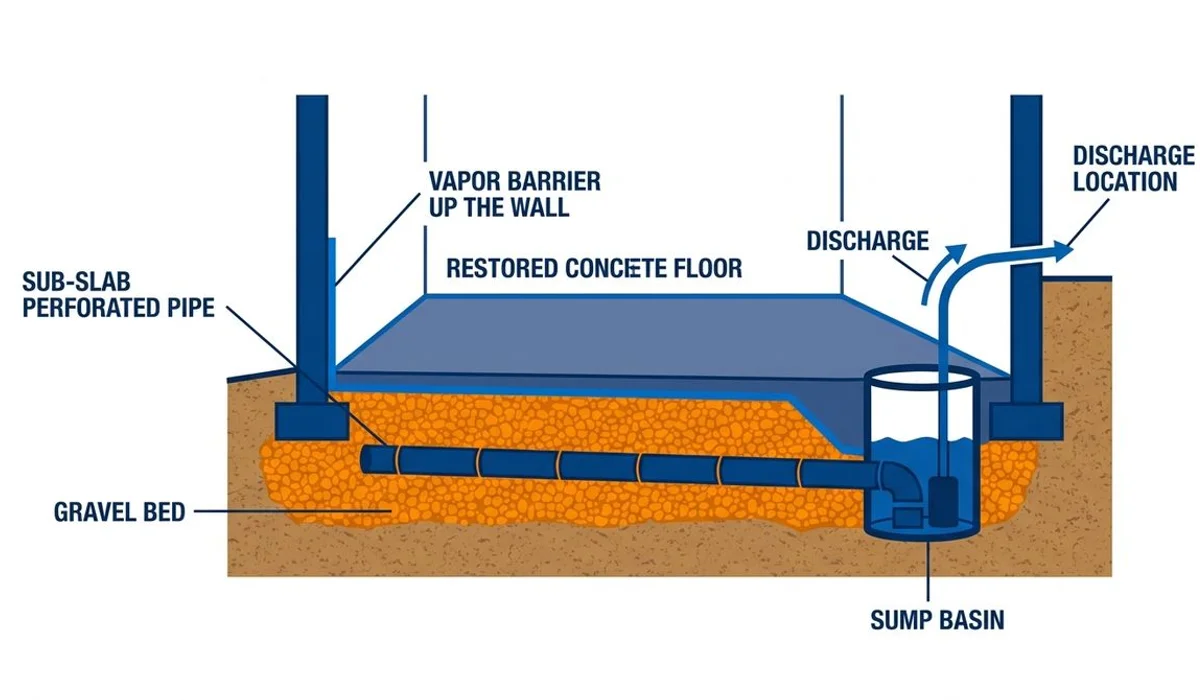
An interior French drain is a sub-slab perimeter system installed inside your basement. It collects groundwater that pushes up through the floor-wall joint and through tiny cracks in the slab. This system then routes that water to a sump basin.
We install a heavy-duty pump, like the cast-iron Zoeller M53, to lift the water out safely. Water pushes up through the foundation because of the incredible weight of the saturated earth outside.
“A single cubic foot of saturated soil weighs over 60 pounds. When the ground floods, that creates thousands of pounds of hydrostatic pressure against your basement walls.”
Our drainage system relieves that immense pressure to stop cracks and floods during Central Oklahoma flash-flood storms. Unlike a sealant or a paint-on coating, an interior drain does not try to hold the water back. It gives the water a clear place to go.
That is the difference between a permanent fix and a bandage that buys you one dry season.
Why OKC basements need this
Oklahoma City sits on a thick layer of expansive clay soil that holds water like a giant sponge. The dominant clay mineral in our region is called montmorillonite. It expands dramatically when wet and shrinks when it dries.
We call this constant movement the shrink-swell cycle. When the water table rises after a heavy rainstorm, this swollen clay pushes against your foundation from every side. Walls begin to weep, and floors start to sweat.
Pretty soon, you find yourself dealing with a completely wet basement. Three specific factors make OKC basements especially vulnerable to water intrusion:
- Expansive montmorillonite clay that swells when wet and shrinks to crack the slab when dry.
- Flash-flood rain that saturates the ground around your foundation in a matter of hours.
- Older homes with limited exterior drainage to divert groundwater before it reaches the wall.
An interior French drain solves the consequence of water in the basement. We recommend this option when fixing the cause, like regrading the entire lot or running an exterior drain, is not possible or affordable. This targeted approach saves you from unnecessary exterior excavation.
How we install it
The installation job has five clear stages. A standard residential basement project usually runs two to four working days.
We keep the process as smooth and clean as possible for your family. Minimal disruption is a top priority for every single project.
1. Saw-cut the slab edge
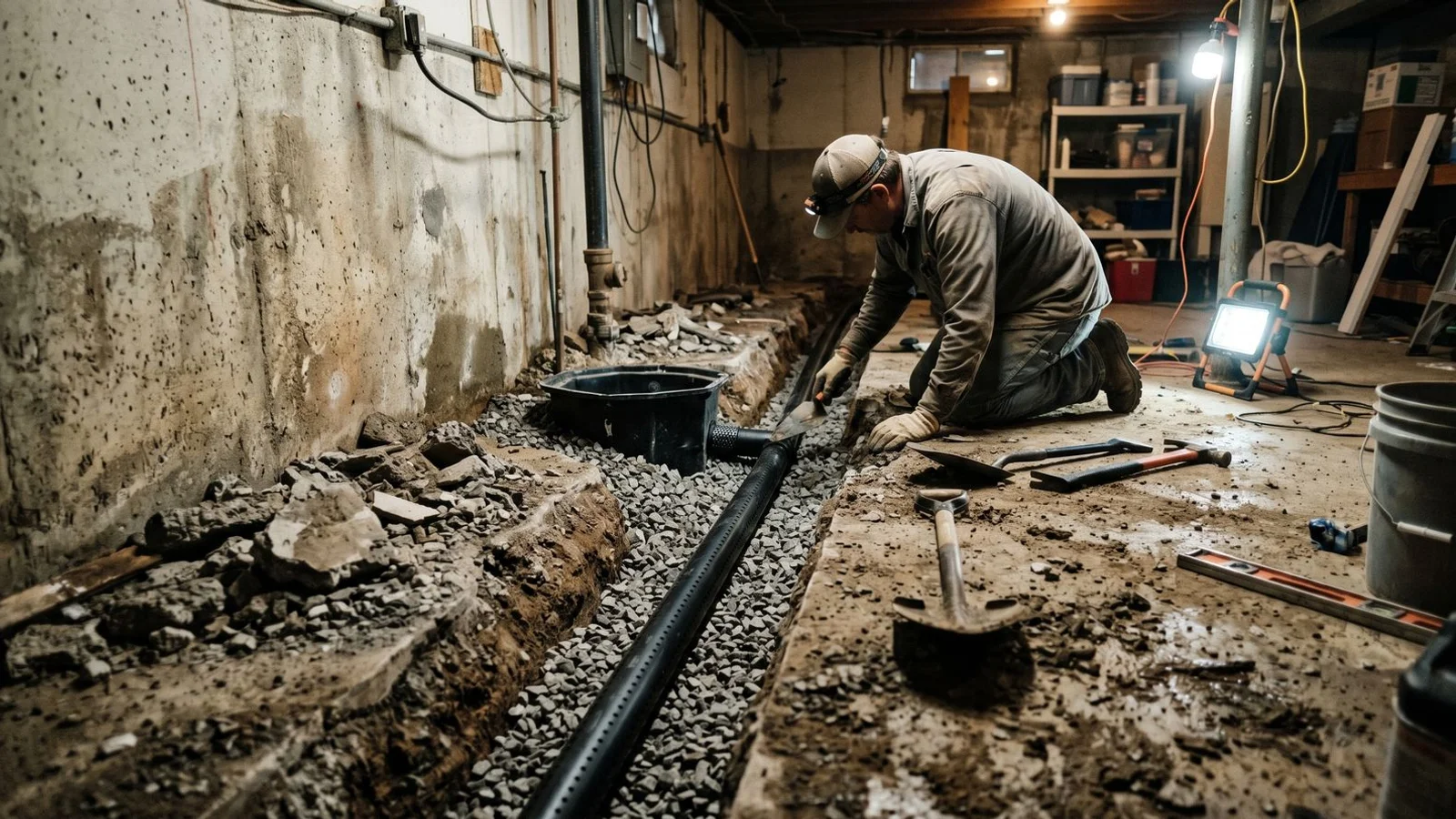
We start by marking the perimeter inside the basement wall. The team saw-cuts the slab about 12 to 18 inches wide to create a precise channel.
This step gives us a clean edge to work against. It also ensures we have a perfectly straight line to pour fresh concrete back against when the piping is finished.
2. Excavate the trench
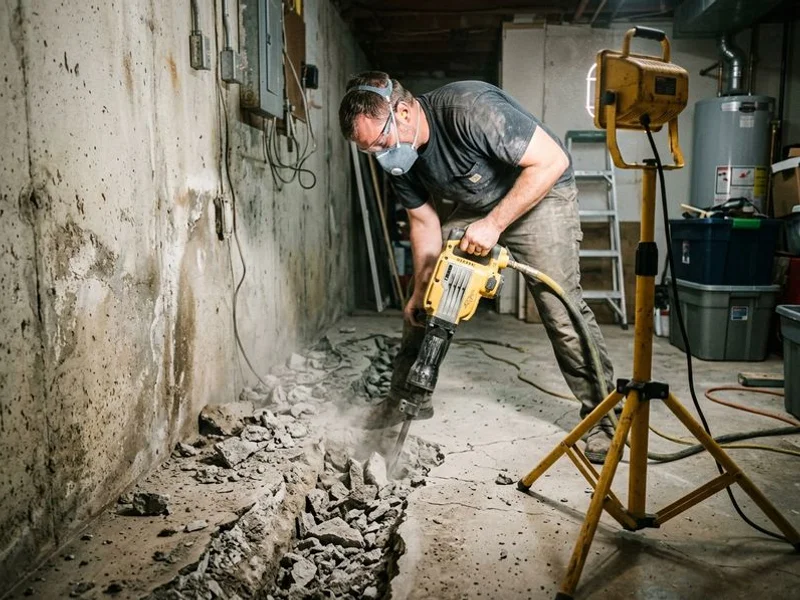
We use jackhammers to remove the cut section of the concrete slab. The crew then digs down 18 to 24 inches below the slab base to create the trench.
The excavation process ensures three critical things:
- The trench reaches the correct depth for a 4-inch pipe.
- The channel falls gently toward the lowest corner of the room.
- The base is wide enough to accommodate the protective gravel bed.
We ensure the trench slopes perfectly so the sump basin catches every drop. Proper gravity flow is essential for the system to work.
3. Set the pipe and gravel bed
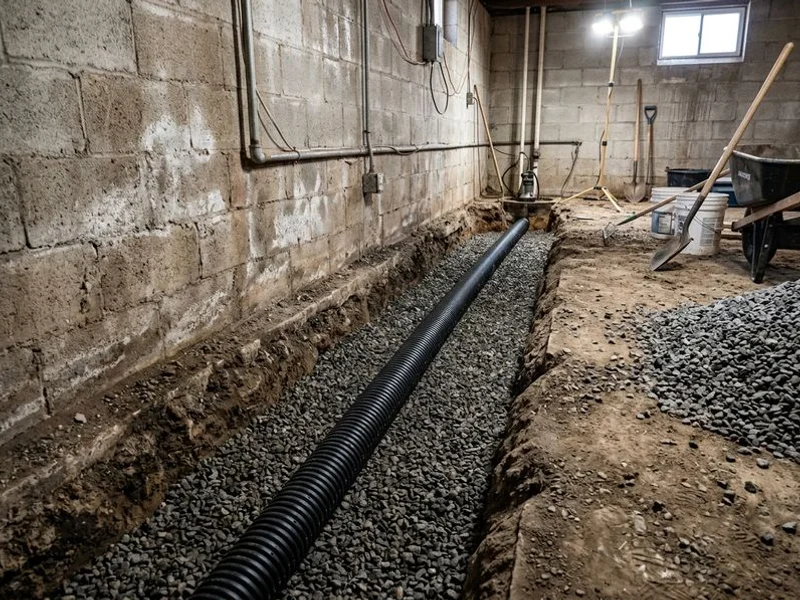
Clean, 3/4-inch washed river rock goes in first to form a highly permeable bed. A 4-inch perforated PVC drainage channel sits directly on top of this gravel.
We slope the heavy-duty pipe carefully toward the sump basin. The technicians then drill weep holes through the base of the foundation wall.
This allows trapped groundwater to pass from behind the wall into the drainage channel rather than building up pressure. We wrap the pipe in a professional filter fabric to ensure silt and clay do not clog the perforations, because long-term reliability depends on keeping that pipe clear.
4. Install the sump basin and pump
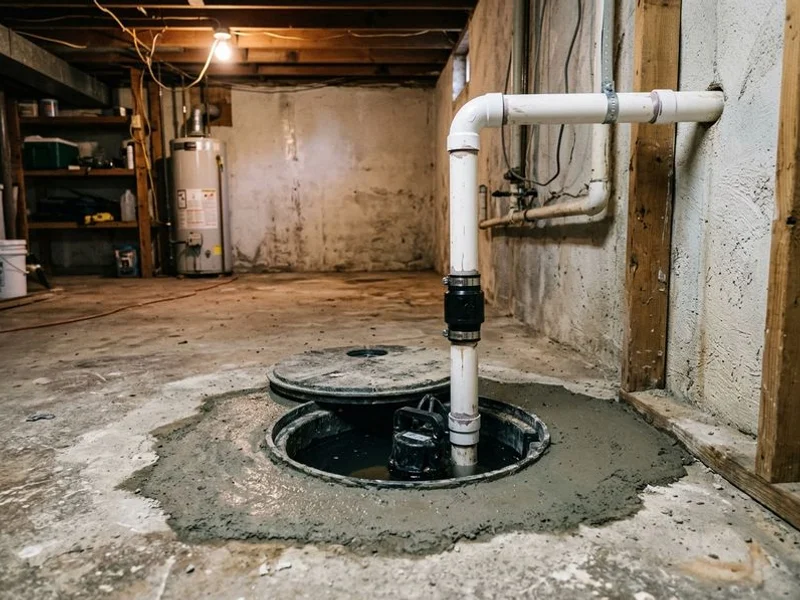
The basin sits perfectly flush in the lowest corner of your basement. It is plumbed to receive all the water from the new perimeter pipe.
We lower the pump into the basin next. A check valve is installed on the pipe so water does not slosh back down when the pump cycles off.
| Sump Pump Type | Ideal Application | Typical Capacity |
|---|---|---|
| Standard 1/3 HP | Normal residential groundwater control | 2,000 - 2,500 GPH |
| Heavy-Duty 1/2 HP | High water tables or heavy flash floods | 3,500 - 4,300 GPH |
| Battery Backup Pump | Power-loss protection during storms | 1,500 - 2,000 GPH |
The discharge line runs straight to the exterior and safely away from your foundation. It terminates at a pop-up emitter or a curb fitting depending on your local city code.
5. Vapor barrier, gravel cap, and concrete
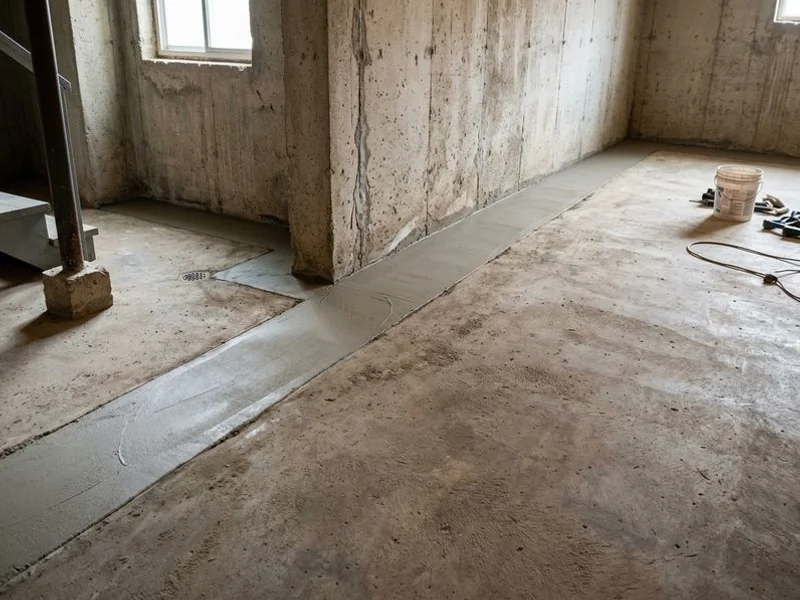
We lay a thick vapor barrier over the trench to prevent ground moisture from wicking upward. The crew tops the gravel off and pours fresh concrete completely flush with your basement floor.
When the job is done, the perimeter looks like a clean concrete border instead of a messy construction zone.
Honest pricing
OKC pricing for interior French drains remains fairly consistent across the local market. You can expect to pay $50 to $60 per linear foot for a full sub-slab installation in 2026.
We typically see a standard residential basement run between $5,000 and $6,000 total. This price includes the trenching, the 4-inch pipe, the vapor barrier, and the concrete restoration. A quality 1/3 HP sump pump unit adds roughly $175 to $225 to the material costs.
Several factors can move your total price up:
- Thick or reinforced concrete slabs that take much longer to cut.
- Finished basements that require careful interior protection and dust control.
- Long discharge runs needed to reach a safe, gravity-fed exit point outside.
- Code-required upgrades like a battery backup pump or dual-pump systems.
We never quote you an artificially low number just to win the job. The sales team refuses to hit you with expensive extras after the trench is already open.
The quote you sign is the exact price you pay. We will only adjust the price if we discover something genuinely hidden, like a buried utility line or an unmapped footing. If that happens, a project manager will talk to you and get your approval before making any changes.
When interior is the right answer (and when it isn’t)
Interior French drains are absolutely the right call in several specific situations. You should consider an interior system when:
- Groundwater is actively showing up at the floor-wall joint.
- The basement floor sits below the lowest gravity-fed exit point on your lot.
- Exterior drainage simply is not feasible due to large mature trees, hardscaping, or concrete poured right up to the foundation.
- You have already tried sealants or surface drains, but the water still gets inside.
- The structural slab shows horizontal cracks along the perimeter, which indicates hydrostatic pressure building over the years.
Interior drainage is not the right answer for every single water problem. You should look at other options when:
- Water is coming in high on the basement wall. This usually indicates a downspout or surface drainage issue, not hydrostatic pressure.
- The yard has obvious grading problems that an exterior French drain or surface drainage system would solve for a much lower cost.
- The existing drainage system is just clogged with roots or mud. We can easily get it hydro-jetted clean for a fraction of the replacement cost.
We will tell you exactly which category your home falls into during our free evaluation. If the answer is not interior drainage, the technician will gladly point you toward the cheaper fix.
Ready for a dry basement?
Are you ready to reclaim your basement and stop worrying about the next heavy rainstorm?
We offer a completely free on-site evaluation across the entire OKC metro area. A trained technician will map out your exact water entry points and check your slab for damage.
We will then provide a firm interior French drain installation plan with absolutely no obligation to buy.
Reach out to the team today, and let us help you keep your home safe and dry.
Last Updated: June 3, 2026